
2005 Suzuki KingQuad 700 EFI
| The Long Awaited Suzuki KingQuad 700 EFI The legend Reborn! |
 |
 In 2001 Suzuki recommitted to the ATV industry with the start of a complete new line-up and ever since with each new year a new and well engineered ATV has been released so why would I be surprised with the introduction of the new 2005 LT-A700X KingQuad? Why indeed? I must say I was surprised, from the first time I heard of the new KingQuad I expected another great ATV. The real surprise came when I actually had my first ride, that’s when the total package showed through. The new KingQuad highlights design and planning with several key issues showing through, a smooth yet aggressive EFI engine, superior comfort ride, easy steering, low maintenance and the proper
 combination of power supplying traction. The new kingQuad was designed to compete with the other large displacement sport utility ATVs on the market and offer all the highly demanded features at the lowest in class price. When Suzuki engineers started brain storming the new KindQuad they worked in a true team spirit by setting basic structures and then building off those to produce the best package, big displacement sport utility ATV they could engineer.
 A 695cc, single-cylinder, double overhead camshaft, 4 valve, liquid cooled, four-stroke, electronic fuel injected engine powers the mighty KingQuad. Suzuki knew this engine had to perform  well, especially with the recent introduction of several models in the fairly new sport utility segment. There is no doubt the 700 engine is the most progressive ATV engine Suzuki has ever produced. As a leader in motorcycle fuel injection, the GSX-R sport-bike technology has been transferred into the ATV segment and Suzuki has made the new design work well. Just as with the GSX-R, engineers were looking to produce quality air flow into the cylinder, that’s where the motorcycle adaptations started. The air-box and air filter are placed directly over the intake port which supplies the cylinder with the fuel/air mixture. This design creates little fuel/air restriction into the cylinder and provides a simple but effective way to control the fuel/air mixture by use of a throttle body type fuel injection. Twenty years ago this system would have seemed quite complicated but by today’sstandards the fuel injection on a high-end ATV has become expected. The fuel
  system consists of the fuel tank in the rear with electric fuel pump inside. This pump supplies a regulated fuel pressure to the single fuel injector located inside the air intake throttle body. Getting back to the air-box which is located just above the cylinder-head, this air-box position would not be possible if not for the rear fuel tank design. We see this now with more ATVs, the air-box is located high upfront where the conventional fuel tank has always been located. All around benefits include, with the air-box high and up-front, the ability to use the best possible air-flow into the cylinder. The cylinder is now positioned at a 48 degree angle for a lower center of gravity and now the weight of the fuel is lower which also lowers the center of gravity. Technology is changing and with the addition of fuel injection so many other benefits have taken place, including better handling due to keeping most of the ATVs weight low in the units frame. So now we know the fuel/air mixture is supplied to the cylinder via a well designed air-box, throttle body and fuel tank but what provides the injector and throttle body with the information on how much fuel and air to supply? The answer is not really complicated but it is extensive. The system uses sensors in key locations to read the engine’s needs. In the air-box there are two sensors, one located in front of the air-cleaner which is an intake air pressure
  sensor. This sensor reads the atmospheric and air intake pressure. Then just below the air-cleaner in another sensor which reads intake air temperature, this sensor along with the Idle Speed Control (ISC) replace the manual choke and compensate for cold or warm weather starting. Next, we have the Throttle Positioning Sensor. This detects the amount of throttle that has been applied. Moving on we have the Crankshaft Positioning Sensor, this sensor and a 22-trigger-pole type signal generator transmit engine RPM and crankshaft position. Lastly, on the rear of the cylinder head a Coolant Temperature Sensor is located that constantly monitors engine temperature. Each sensor sends information to the ECM (Engine Control Module) this module acts as the vehicles computer processing all the information and then creating two different 3-dimensional grid maps, one for low load and the other for a high load. Basically the ECM calculates the information read by all the sensors and translates a compensation signal that provides another signal which is sent to the injector. With all the engine information being constantly monitored, performance is optimized. The optimum fuel injection volume has been reached and ignition timing has been adjusted providing the best engine performance possible.
 SV1000/S, the dual over-head cam-shafts are driven by a chain and gear cam-shaft drive system. The main timing gear driven by the timing-chain is larger and allows for another gear to be positioned just outside of the larger main gear. At this point, the two camshaft gears are being driven by a main gear with the same ratio and the larger reducing gear is recessed into the cast head structure. In-short this type of gear driven timing system allows for the cylinder-head to be smaller in size. Let’s dig just a bit deeper now, looking into the engines crankshaft. We have already established the cylinder-head is positioned at a 48 degree angle. Also, as with almost all Suzuki
  engines, the aluminum cylinder walls are Plasma Spray Coated (SPSC). Suzuki has done well with the light weight Plasma Spray Coating. We have not seen any issues in this area. Perhaps one of the most interesting features of this engine are the two balancer shafts located one in front and one behind the crankshaft counterweight. These balancer weights along with rubber engine mounts reduce engine vibration to almost nil. The 695cc engine has a bore and stroke of 102 x 85mm, Suzuki engineers chose this combination for the ability to supply abundant low-to-mid range power. Lastly, the 700 engine uses a forged aluminum-alloy piston and a lightweight L-shaped top compression ring for better sealing and to generate dependable power.
 We have seen this type of transmission from Suzuki before, the QuadMatic with V-belted continuously variable transmission and centrifugal clutch. The transmission has been offered in the Vinson as well as the Eiger this configuration works and it works well. The QuadMatic Transmission never allows the belt to become loose or slack at any point. The braking point between engine power and transmission is done by the means of the centrifugal clutch just behind the primary belt clutch. Other automatic transmissions just rely on the belt as the braking point for engine power to transmission, allowing the belt to sit idle on a rotating pulley. This in turn reduces belt life and engine braking ability. New features include an easy to see and use gate-style drive select lever which makes for easy shifting between Hi, Lo, Neutral and Reverse and a handlebar mounted push button four-wheel drive button with a locking differential setting. That’s right the locking front differential is back. The KingQuad offers three drive modes, 2WD, 4WD and front-differential locked 4-WD. The locking front differential may be something you would expect from the KingQuad but don’t expect the center positioned locking lever that hampered the older models. No, this unit is push button with slide lever for true 4WD locking position. Downfalls of this is the ability to only use the locking front differential when in low range and the handlebar override button that must be depressed for use. The ability to use the locking differential only in low range, that is not drastic but I really don’t like having to hold the override button in for full throttle response in differential lock.
As with any ATV, the frame is the backbone of the product and this unit is no different. When engineers started on this project there were so many aspects that needed attention, rear gas tank, up front air box and the fully independent suspension. 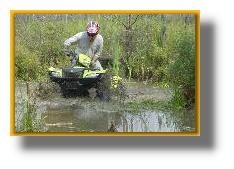 That’s right once again we have the tendency to say the King is back, now just as the original KingQuad the new KingQuad is designed with a new and well thought out fully independent suspension. Starting up front, the KingQuad uses an independent double-wishbone suspension with 7.1 inches (180mm) of travel. The five-way-adjustable spring preload shock absorbers are mounted to the frame on the top and then positioned on a single upper suspension arm, and then just below the upper ball-joint is the hub/axle which is secured to the lower A-arm by the lower ball-joint. Although, the front suspension is only attached to the frame by a single upper suspension arm and the lower A-arm, we felt only positive results. In fact, the combination of smooth front suspension and good steering geometry made the KingQuad standout with light controllable steering and extremely good handling. Moving to the rear we found yet another well designed feature, the 700’s independent rear suspension. The rear IRS is very similar to the front with a single upper suspension arm and alower A-arm, only in the rear a
  stabilizer mechanism and the rear five-way-adjustable spring preload shocks are attached to the lower a-arm. We noticed the long travel rear suspension with 8.1 inches (205mm) of travel implemented an effective ride, allowing the rear of the ATV to squat slightly on acceleration but yet hold tight with very little body roll while cornering at speed. Actually, the ride was very plush with plenty of backbone while cornering at speed or on off-cambers (side-hills). In a short time, I felt completely comfortable on the unit and felt that I could predict how the ATV would handle. There were no handling issues or surprises. Although, the KingQuad has excellent engine braking there are still times when strong braking is necessary and emergency stopping or quick stopping is not a problem. The front brakes consists of dual 7.9 inch (200mm) diameter hydraulic disc brakes with large new pin-slide design single piston calipers. The rear is very similar to the already proven Kawasaki integrated rear differential wet-brake system. Although similar, Suzuki points out this is not a Kawasaki rear differential, the sealed, oil bathed, multi-plate internal rear brake uses 7 plates which are housed in
 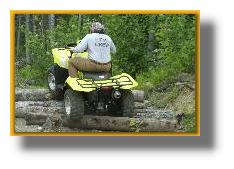 the rear cast aluminum differential housing. The inner workings simulate a manual wet-clutch, braking is superior over conventional brakes in use as well as maintenance. When it comes to traction the KingQuad is dialed-in correctly, it may be the combination of independent suspension, true locking 4WD, vast power and specially designed Dunlop tires. I’m not sure but one of my biggest surprises was how well the unit could accelerate in adverse conditions. Dunlop has specifically designed a new AT25 x 8-12 front and an AT25 x 10-12 rear set of tires for the new KingQuad and the unique design provides traction with comfort. The new tire wheel combination is sure to be lighter since the rims are now pressed from aluminum alloy instead of cast from aluminum and less wheel weight reduces unsprung wheel weight for a more productive suspension.
These days its all about styling and nothing differs from Suzuki, high fenders and aggressive lines make the KingQuad an impressive looking machine. Colors include Hunter Green and Suzuki’s Champion Yellow. We did notice the racks have reduced in size and the front of the new machine is made primarily of plastic body material. Plastic is nice when it comes to scratch resistance and bumps but the lower aesthetic plastic panels can be ripped easily in swamps or extreme mud holes. The unit has two 30/30 watt multi-reflector headlamps designed into the front bodywork and a 40 watt handlebar mounted driver directional head lamp for night trail use and lastly a tail/brake-light for safety. A well lit multi-function digital LCD display shows speedometer, odometer, twin trip meters, hour meter, clock, fuel gauge, and drive range, mode, 4WD indicators. Rider position is high and forward, a surprisingly comfortable position, the T-shaped seat supplies plenty of room for body movement and is well padded for comfort. Leg position is also comfortable with plenty of room for heavy boots in the floorboard area, mud protection was more than adequate and after a day of riding no body parts were sore. Although, the racks seem small they can handle 66lbs (30kg) up front and 132lbs (60kg) in the rear. Towing firewood or faming implements won’t slow the machine down with a towing capacity of 992lbs (450kg), and the tow hitch is standard equipment. The LT-A700X is pre-wired and winch ready, full underbelly protection and two storage compartments add to the units function. Specifications include a dry weight of 602lbs (273kg), length of 83.5 inches (2,120mm), width of 47.6 inches (1,210mm), and ground clearance of 10.2 inches (260mm).
I’m sure ATV publication titles everywhere will read “The King Is Back”, only the original KingQuad could not compare to the new 2005 KingQuad 700. Every aspect of the original ATV has been upgraded, new technology and better design have formed a do everything well ATV. From the first time I stepped a leg over this unit I knew my ride was going to be special. I was surprised at how well the KingQuad rode and just how comfortable and easy it  was to ride. Positive points are many, great rider position, the best and most comfortable ride I’ve encountered to date, outstanding engine power which is transferred into industry leading traction, electronic fuel injection that works no matter where or what conditions you ride in, well thought ergonomics and Suzuki dependability with class leading technology. My complaints are few, I did not like the override button or rev-limiter when in 4WD. I felt the fuel injection could have accelerated just a bit more at first throttle (something Suzuki has told me is an easy adjustment). Not that the machine does not have enough power, it’s just that I like hard hitting power off the line and I felt the first indication of power could hit just a bit harder. Although, our day of testing was short, only about seven hours, I gained a great amount of respect for the new KingQuad. Testing the unit on all types of trails, some fast and some slow, even deep water and mud, trail conditions were varied but the result was always the same. The KingQuad is the new must have ATV especially in the sport utility segment. The KingQuad joins a long list of sport utility ATVs, but I think it’s easy to choose when a unit comes in with great reviews and when it’s also priced the lowest in its class at ,199 US. Expect to see the first units at dealers late September 2004.