
ATV Review: 2011 Yamaha Grizzly 450 EPI
By: Jason Giacchino

Power steering is far from a new concept. Patents were filed way back at the turn of the last century and cars were coming equipped with the technology by the early 1950s. The ATV was a bit later to adopt such ideals, the first OEM power-steering equipped model coming from Yamaha.
Yamaha has been very wise about their integration of this unique feature, having begun showcasing electronic power steering’s (EPI) benefits back in 2006 on their flagship Grizzly 700 then following up by equipping their midsize Grizzly 550 with it. All the while the Grizzly 450 sat idle while Yamaha’s engineers quietly penned up a full makeover that would put it right in the hunt with its two bigger brothers.
For 2011, the Grizzly 450 packs such goodies as an all-new independently suspended frame, the same no-slip CVT belt automatic transmission as the 550 and 700, and of course the much praised electronic power steering package.
Framed
Yamaha is pretty proud of the new frame they developed for the Grizzly 450 and with good reason. Having made the transition to a one-piece unit (without a bolt-on subframe) has shaved a solid 20-pounds over the steel it replaces.
A new rear swaybar is both shorter and stiffer and Yamaha claims that even with the requisite weight gains that come with adding power steering, the wet weight of the Grizz has dropped roughly 10-pounds over last year’s model.
Power Plant
Surprising to some, the liquid cooled 421cc 2-valve (single overhead cam) four stroke providing the go-juice on the Grizzly 450 has not made the transition to fuel injection like the two larger models it emulates. Instead fuel and air are blended in the tried and true gravity-fed method of the 33mm Mikuni carburetor; the logic here being keeping price down a priority over creating a near-identical clone of the 550 & 700.
Transmission
Just like with the two bigger Grizzlies before it, the 2011 450 shares a high-end CVT no-slip belt automatic transmission, centrifugal clutch and shaft final drive. Becoming ever rare, the Grizzly 450 is one of few utility ATVs that allows for 2WD operation to conserve fuel when the going is good. 4-wheel drive actuation is push-button electronic as is the option of locking the front differential.
Chassis
The Grizzly 450 comes in at 43-inches wide with a 48.5-inch wheelbase. An independent shock at each tire offers preload-only adjustability (front travel comes in at 6.3” and rear at 7.1”). It weighs in at 620 pounds (with fluids) and boasts a towing capacity of 1,322 pounds.
Steel cargo racks offer a special, extra-durable wrinkle paint finish feature a combined cargo capacity of 264 pounds (88 front, 176 rear).
Odds and Ends
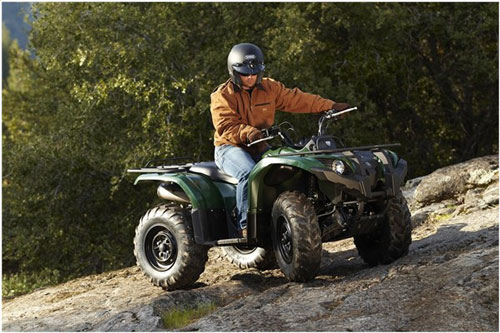
The 2011 Grizzly 450 is chock full of interesting specs worth mentioning. Starting is push button electric but Yamaha includes a back-up recoil starter should you manage to drain your battery. Air filter access is of the no-tool variety and a simple, washable foam filter resides in the air box. Valves boast screw type adjustment (again the goal here being simplicity to encourage maintenance), and a new multi-plate rear brake is sealed to keep mud grime and grit out of the internals. The underbelly comes equipped with functional high-impact plastic skid-plate protection and finally Yamaha wisely routed the air intake way up near the gas cap to insure stall-free performance through the deepest mud.
Price
MSRP starts at ,499 while a 0 up-charge nets a Limited Edition (LE) model boasting cast aluminum rims and a 2-inch receiver hitch. Finally a Realtree Camo scheme-equipped Grizzly 450 can be had for an additional , bringing the total up to ,849.
Note that Yamaha is also offering a non-EPS equipped Grizzly 450 for ,899 – ,249.
The Ride
Technical breakdowns are fine and well but like you, our editors were all too aware of the fact that the real merits and shortcomings of the Grizzly 450 would be discovered out on the soupy winter trails.
The Grizz fired up with only the slightest push of the electric start button and a bit of choke fed through the bar-mounted enrichment dial on the cold mornings. It always idled clean and crisp with no discernable difference between it and the fuel injected models (of course we imagine elevation changes would be better suited to the automatically-adjusting EFI setup).
For a utility-oriented model, the Grizzly 450 accelerates with surprising pep. The EPS makes high-speed cornering an absolute breeze but it’s the slow speed maneuvering (especially in 4-wheel drive) that yield the most noteworthy gains. We are used to experiencing the effortlessness of power steering on only the largest and beefiest ATVs so, as expected, outfitting an already fairly nimble model with it results in a machine that handles like nothing before it!
It’s almost sacrilege to keep praising this ATV for what it surely considered a walk in the park, but the Grizzly 450 is an absolute natural on tight trails. It zips in and through areas that cause larger machines to flatten brush.
The automatic transmission takes the guesswork out of even the nastiest situations and a one-way “sprag” clutch applies engine braking to prevent freewheeling when the ground starts falling away to slope.
The suspension action is surprisingly decent despite a lack of adjustability options and travel numbers that are dwarfed by some of the more recent utility entries thanks to the combination of a rigid frame design coupled to fully independent suspension. We were quite unable to upset the Grizzly on rocks, roots and moderate off-cambers.
At nearly 11-inches, ground clearance is also commendable. We were particularly impressed with the Grizz 450’s ability to straddle trail obstructions that we feared might bottom a shock or dent a rim. The responsiveness of the EPS is equally credited for this confidence booster.
The Yamaha absolutely loves mud pits and deep-water crossings. That high-mounted air intake and sealed belt-drive (and rear brake) we mentioned earlier really shine when soupy mud or H2O come into the equation. We submerged our test unit in cold, fast moving NY mountain-river right up to the seat and the engine never skipped a beat.
Conclusion

Yamaha’s got a winner on its ever-expanding line with the 2011 Grizzly 450. By incorporating all of the features that make the Grizzly 700 & 550 so desirable, Yamaha has turned the 450 into a serious midsize contender. A few of our testers went as far as to say they could no longer justify the increased cost or bulk of the 700s after riding the 450!
About the only thing Yamaha left for improvement in future designs would be the integration of fuel injection and even then, we’re talking negligible performance gains but the ability to take the machine to any elevation without jetting concerns.
Specs
Engine
421cc, 4-stroke, liquid-cooled single; SOHC, 4 valves Bore x Stroke 84.5 x 75.0mm
Compression Ratio 10.0:1
Carburetion Mikuni 33mm BSR
Ignition DC-CDI
Starting System Electric
Transmission Yamaha Ultramatic V-belt with all-wheel engine braking/H, L, N, R, P
Drive Train Yamaha On-Command pushbutton; 3-way locking differential;
2WD, 4WD, locked 4WD; shaft drive
Chassis
Front Suspension Independent double wishbone; 6.3-in travel
Rear Suspension Independent double wishbone; 7.1-in travel
Front Brakes Dual hydraulic disc
Rear Brakes Sealed oil bathed, multi disc
Front Tires AT25 x 8-12
Rear Tires AT25 x 10-12
Dimensions
Length/Width/Height 78.5 x 43.0 x 44.1 in
Seat Height 33.1 in
Wheelbase 48.5 in
Turning Radius 118 in
Ground Clearance 10.8 in
Fuel Capacity 4.0 gal
Wet Weight 620 lb
Rack Capacity 88 lb Fr./176 lb Rr.
Towing Capacity 1322 lb
Other
Instrumentation Digital LCD multifunction display: speedometer, odometer, dual tripmeter, hour meter, clock, gear position and fuel gauge
Lighting Dual 30W Krypton multi-reflector headlights & 21W/5W brake light
Warranty 6 Month Limited Factory Warranty
Colors Steel Blue; Hunter Green; Realtree AP Camouflage
Contact
What do you think about the Yamaha Grizzly 450 EPI? Have experience with it? Does it interest you? Do you not care? Whatever you thoughts, discuss it here!