


Wont start...tao tao 250cc
 Oct 24, 2012 | 01:02 PM
#1

Thread Starter
|
Weekend Warrior
Joined: Aug 2012
Posts: 13
Likes: 0
 Wont start...tao tao 250cc
Started I had a dead battery, I jumped it to my car and after a few cranks...started up. Replaced the battery and now cranks but no start. I am getting gas, choke is OK and kill switch is disabled pulled spark plug, seems like no spark. Replaced the coil, no change. Put on a space CDI and still the same...please help
help
help
Oct 25, 2012 | 12:18 AM
#2

Electrical Expert
Likes High Voltage In The Tub!
Likes High Voltage In The Tub!
Joined: Dec 2008
Posts: 3,260
Likes: 14
From: Tracy, California, USA
"Seems like no spark" is not a good enough answer. Do you have spark or not? Let's find out for sure...
1) Pull out the plug, reconnect it to the ignition coil.
2) Set all kill switches to the 'run' position.
3) Crank the starter motor while holding the spark plug threads up against the engine block.
4) While cranking the starter, dod you see regular spark occuring about 10 times per second?
A) Do you know if your CDI is DC powered or AC powered?
B) Does your CDI have 6 pins - two connectors, with one being 2 pins and one being 4 pins?
1) Pull out the plug, reconnect it to the ignition coil.
2) Set all kill switches to the 'run' position.
3) Crank the starter motor while holding the spark plug threads up against the engine block.
4) While cranking the starter, dod you see regular spark occuring about 10 times per second?
A) Do you know if your CDI is DC powered or AC powered?
B) Does your CDI have 6 pins - two connectors, with one being 2 pins and one being 4 pins?
Oct 25, 2012 | 01:37 PM
#3
Thread Starter
|
Weekend Warrior
Joined: Aug 2012
Posts: 13
Likes: 0
Update, replaced starter coil and plug, started up fine twice...shut down for 10 min. and back to no start, plug is clean. CDI is DC, kill switch is disconnected and yes the CDI is 6 pin with 2 connecters. Possible I disturbed wires or something that could be loose ?
Oct 27, 2012 | 05:55 PM
#4
Thread Starter
|
Weekend Warrior
Joined: Aug 2012
Posts: 13
Likes: 0
Update
Found 1 worn wire against the steering but still have something here...stared 2 more times easily but then wont start...getting there, something in the wiring !
 Oct 27, 2012 | 09:42 PM
#5
Electrical Expert
Likes High Voltage In The Tub!
Likes High Voltage In The Tub!
Joined: Dec 2008
Posts: 3,260
Likes: 14
From: Tracy, California, USA
Below is the generic procedure for troubleshooting a DC powered 6 pin CDI ignition system.
But you have an intermittent failure. That is a lot tougher. It is really important that you keep track of your measurement data compared to whether the quad starting or not starting. It does no good at all to measure voltages or resistance measurements when the quad is starting. You need to make sure that any measurement data you post is 100% done when the quad wasn't starting. If you post measurement data from when the quad is working, all that will prove is that the quad is working at that moment in time.
But you have an intermittent failure. That is a lot tougher. It is really important that you keep track of your measurement data compared to whether the quad starting or not starting. It does no good at all to measure voltages or resistance measurements when the quad is starting. You need to make sure that any measurement data you post is 100% done when the quad wasn't starting. If you post measurement data from when the quad is working, all that will prove is that the quad is working at that moment in time.
To troubleshoot no spark problems on a 6 pin DC powered CDI it makes sense to start in the middle (the CDI), measure as much as we can and branch out from there. For the CDI to do its thing it needs power, a trigger pulse, and it must not be inhibited via the kill switch input pin.
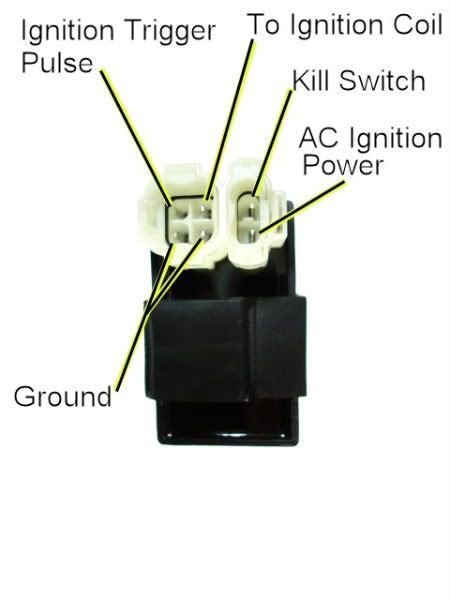
1) Unplug the CDI. Turn the ignition switch on. Set all kill switches the the "run" position. In the wiring harness, look to see if you have a wire on the kill switch pin. If you do, measure the resistance of the kill switch pin to the ground pin on the 20K ohm scale. It should read infinite ohms (same as when the meter leads are hanging free and not touching anything). It should not read zero ohms (shorted).
2) Leave the CDI unplugged. Turn off the ignition switch. Set your meter to the lowest resistance scale you have (like 2 ohms or 20 ohms full scale). Measure the resistance of the "Ignition Coil" pin in the wiring harness to the ground pin. You should read something around 0.7 ohms (but not zero ohms). What do your measure?
3) Leave the CDI unplugged and the ignition switch off. Set your meter to the lowest resistance scale you have (like 2 ohms or 20 ohms full scale). Measure the resistance of the "Ground" pin in the wiring harness to the the negative battery terminal. You should read zero ohms. What do your measure?
4) Leave the CDI unplugged, and turn the ignition switch into the "on" position. Use a meter to measure the DC voltage on the pin labeled "AC ignition power" in the wiring harness to the ground wire on the 20 volt DC scale. You should read battery voltage (12 volts). What do you measure?
5) Leave the CDI unplugged. Use a meter to measure the resistance of the "Ignition Trigger Pulse" pin in the wiring harness to the ground wire on the 2K ohm scale. You should read approximately 150 ohms. What do you measure?
6) Set your meter down to the lowest scale you have for measuring AC volts. 2 volts would be ideal, but some meters don't go that low. In that case use the lowest scale you have. While cranking the engine, measure the voltage on the Ignition Trigger Pulse pin in the wiring harness to the ground pin. You should measure 0.2 to 0.5 volts AC. What do you measure?
7) Now plug the CDI back in. Measure the AC voltage on the Ignition Coil pin to the ground pin using the 200 volt scale. If you have to, use a sewing pin to poke through the wire insulation and then put the meter probe on the sewing pin. But don't hold your fingers on the connection during the next test - there may be high voltage here when the engine is turning. With the ignition on and all kill switches set to the "run" position, crank the starter motor. You should see voltages bouncing around at random values and the meter captures all or part of a spark event. What do you see?
1) Unplug the CDI. Turn the ignition switch on. Set all kill switches the the "run" position. In the wiring harness, look to see if you have a wire on the kill switch pin. If you do, measure the resistance of the kill switch pin to the ground pin on the 20K ohm scale. It should read infinite ohms (same as when the meter leads are hanging free and not touching anything). It should not read zero ohms (shorted).
2) Leave the CDI unplugged. Turn off the ignition switch. Set your meter to the lowest resistance scale you have (like 2 ohms or 20 ohms full scale). Measure the resistance of the "Ignition Coil" pin in the wiring harness to the ground pin. You should read something around 0.7 ohms (but not zero ohms). What do your measure?
3) Leave the CDI unplugged and the ignition switch off. Set your meter to the lowest resistance scale you have (like 2 ohms or 20 ohms full scale). Measure the resistance of the "Ground" pin in the wiring harness to the the negative battery terminal. You should read zero ohms. What do your measure?
4) Leave the CDI unplugged, and turn the ignition switch into the "on" position. Use a meter to measure the DC voltage on the pin labeled "AC ignition power" in the wiring harness to the ground wire on the 20 volt DC scale. You should read battery voltage (12 volts). What do you measure?
5) Leave the CDI unplugged. Use a meter to measure the resistance of the "Ignition Trigger Pulse" pin in the wiring harness to the ground wire on the 2K ohm scale. You should read approximately 150 ohms. What do you measure?
6) Set your meter down to the lowest scale you have for measuring AC volts. 2 volts would be ideal, but some meters don't go that low. In that case use the lowest scale you have. While cranking the engine, measure the voltage on the Ignition Trigger Pulse pin in the wiring harness to the ground pin. You should measure 0.2 to 0.5 volts AC. What do you measure?
7) Now plug the CDI back in. Measure the AC voltage on the Ignition Coil pin to the ground pin using the 200 volt scale. If you have to, use a sewing pin to poke through the wire insulation and then put the meter probe on the sewing pin. But don't hold your fingers on the connection during the next test - there may be high voltage here when the engine is turning. With the ignition on and all kill switches set to the "run" position, crank the starter motor. You should see voltages bouncing around at random values and the meter captures all or part of a spark event. What do you see?
Oct 28, 2012 | 01:24 PM
#6
Thread Starter
|
Weekend Warrior
Joined: Aug 2012
Posts: 13
Likes: 0
Thanks
Below is the generic procedure for troubleshooting a DC powered 6 pin CDI ignition system.
But you have an intermittent failure. That is a lot tougher. It is really important that you keep track of your measurement data compared to whether the quad starting or not starting. It does no good at all to measure voltages or resistance measurements when the quad is starting. You need to make sure that any measurement data you post is 100% done when the quad wasn't starting. If you post measurement data from when the quad is working, all that will prove is that the quad is working at that moment in time.
But you have an intermittent failure. That is a lot tougher. It is really important that you keep track of your measurement data compared to whether the quad starting or not starting. It does no good at all to measure voltages or resistance measurements when the quad is starting. You need to make sure that any measurement data you post is 100% done when the quad wasn't starting. If you post measurement data from when the quad is working, all that will prove is that the quad is working at that moment in time.
It will take me a few days to check all this....dumb hurricane sandy starts tonight and I have work [ I am a industrial mechanic ] I love this site for help and I'll post as soon as I can get to this, Thanks again.
Oct 29, 2012 | 11:49 AM
#7
Thread Starter
|
Weekend Warrior
Joined: Aug 2012
Posts: 13
Likes: 0
Cdi
While it was running I wiggled and tugged on all wires, when I came to the CDI the engine sound changed, gave it a shake and it shut off..think its a bad connector in the plug !

Trending Topics

Thread
Thread Starter
Forum
Replies
Last Post
yamahagye
Yamaha
7
Sep 28, 2002 03:45 PM

Currently Active Users Viewing This Thread: 1 (0 members and 1 guests)