


Storing a single cylinder motor
 Nov 6, 2009 | 10:01 AM
#1

Thread Starter
|
Pro Rider
Joined: Aug 2008
Posts: 1,317
Likes: 0
 Storing a single cylinder motor
Wouldn't it be best to get the piston at TDC on the compression stroke for long term storage? That way no moisture or anything could get into the cylinder. Just wondering.
Nov 6, 2009 | 10:22 AM
#2

Extreme Pro Rider
God forbid he lets the polishing secret out!
God forbid he lets the polishing secret out!
Joined: Jul 2006
Posts: 11,805
Likes: 0
Fog the motor, and put gas stabilizer in the gas tank.
While the engine is running, and spray fogging oil into the air intake. Give it an extra heavy shot just as the engine starves and dies.
Here a pic of one brand but there all good enough.
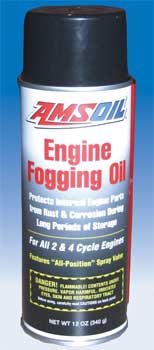
While the engine is running, and spray fogging oil into the air intake. Give it an extra heavy shot just as the engine starves and dies.
Here a pic of one brand but there all good enough.
Nov 6, 2009 | 10:46 AM
#3
Thread Starter
|
Pro Rider
Joined: Aug 2008
Posts: 1,317
Likes: 0
"Fog the motor, and put gas stabilizer in the gas tank."
Yes. I do both of these. But, as an extra precaution, wouldn't it be best to get the piston at TDC on the compression stroke? Specifically, I'm talking about my Troy Bilt Chipper & tiller. Both are 8hp Briggs motors.
Yes. I do both of these. But, as an extra precaution, wouldn't it be best to get the piston at TDC on the compression stroke? Specifically, I'm talking about my Troy Bilt Chipper & tiller. Both are 8hp Briggs motors.
Nov 6, 2009 | 12:23 PM
#6
Extreme Pro Rider
God forbid he lets the polishing secret out!
God forbid he lets the polishing secret out!
Joined: Jul 2006
Posts: 11,805
Likes: 0
Not really that fog oil gets into all over those parts also. Remember your spraying it into a running motor until it stalls so its gets into everything,head,rockers,valves,cams.wrist pins. Even the crank case if it was a 2 stroke.
Nov 6, 2009 | 01:17 PM
#7
Thread Starter
|
Pro Rider
Joined: Aug 2008
Posts: 1,317
Likes: 0
Ok. I guess I was more concerned with foreign objects getting into the cylinder. I had a motorcycle once where mice got into the muffler and built a nest in the pipe. So I guess I was thinking if mice can do that, it would be possible for bugs or ants or even moisture to get into the cylinder via the valves. Either thru the carb or thru the exhaust.
Trending Topics
Nov 6, 2009 | 01:35 PM
#8

Pro Rider
Joined: Apr 2005
Posts: 460
Likes: 0
I have a tiller from the old Central Hardware stores that was give to me over 11 years ago with an old 5hp Briggs motor.
It sits outside under a galvanized washtub and has sat as long as 3 years at one time with nothing done to it.....and I mean nothing.
But it runs.......and has never...ever...failed to start.
And it uses no oil.
If it failed on me today, tomorrow or whenever, I have no room to complain about it.
It sits outside under a galvanized washtub and has sat as long as 3 years at one time with nothing done to it.....and I mean nothing.
But it runs.......and has never...ever...failed to start.
And it uses no oil.
If it failed on me today, tomorrow or whenever, I have no room to complain about it.
Nov 6, 2009 | 01:40 PM
#9

Weekend Warrior
Joined: Oct 2009
Posts: 18
Likes: 0
I do turn my engines over to the compression stroke. I've never used fogging oil, but will probably do that now.
I've always just drained the carbs, put stabilizer in the gas, and turned the engine over to compression stroke.
Not saying it's the best, just what I've done in the past without any issues.
I've always just drained the carbs, put stabilizer in the gas, and turned the engine over to compression stroke.
Not saying it's the best, just what I've done in the past without any issues.
Nov 6, 2009 | 02:15 PM
#10
Thread Starter
|
Pro Rider
Joined: Aug 2008
Posts: 1,317
Likes: 0
I just got off the phone with Briggs & Stratton. The guy said it doesn't really matter. In fact, his opinion is that you should leave it on the downstroke between exhaust & intake so that both valves are open. This allows air flow through the cylinder so it keeps moisture out. Much like vents in a crawl space of a house. I told him it seemed that if the valves were closed on the compression stroke, moisture wouldn't get in. He said there is some merit to that thinking but moisture gets in anyway, and when it does, there's no way to get it out. But in the end, he said it really didn't matter. He said "It's a 7 hp Briggs, not a nuclear power plant. Don't worry about it. Where ever it stops, store it." lol