


200cc viva gorilla starting issues.
 Feb 6, 2013 | 07:23 PM
#1

Thread Starter
|
Weekend Warrior
Joined: Feb 2013
Posts: 6
Likes: 0
 200cc viva gorilla starting issues.
Recently picked up a 200cc gorilla ATV from a buddy who hadn't started it in a year or so. Did all the regular starting procedures for a quad that hadn't been started in awhile. No spark at all so I replaced the battery, coil, plug, and cdi still no spark all wires and fuses seem good so go back inside for a couple of hours come back out turn back on and I have spark?????? Didn't touch anything or move anything then took carb off cleaned and reinstalled and no spark again??? Can't understand anyone have any ideas???
Feb 7, 2013 | 09:52 PM
#2
Thread Starter
|
Weekend Warrior
Joined: Feb 2013
Posts: 6
Likes: 0
So I have all the plastics off I can't seem to find any wire issues yet. where should I start with the fact it has a new battery, coil, cdi and just got a new carb in today. 6 pin cdi ac powered tryed disconnecting the kill switch wire from the cdi and no luck there I do have a multimeter and I have read up on some of the testing procedures as posted by Lynn, but don't see much about these larger quads or what the end result ended up as. Just wondering if there may be a different procedure for the larger cc atv's or is it pretty much the same all around? Any help would be greatly appreciated thanks.
Feb 8, 2013 | 09:21 PM
#3

Electrical Expert
Likes High Voltage In The Tub!
Likes High Voltage In The Tub!
Joined: Dec 2008
Posts: 3,260
Likes: 14
From: Tracy, California, USA
The procedure for the 6 pin AC powered CDI is below. It does apply to 200 and 250cc quads. Post the results from the questions in the procedure below and we can go from there. But since your spark is intermittent, you want to be taking all your measurements when spark *isn't* happening. Else if you are getting spark, your measurements will only show that everything is working just fine.
To troubleshoot no spark problems on a 6 pin AC powered CDI it makes sense to start in the middle (the CDI), measure as much as we can and branch out from there. For the CDI to do its thing it needs power, a trigger pulse, and it must must be inhibited via the kill switch input pin.
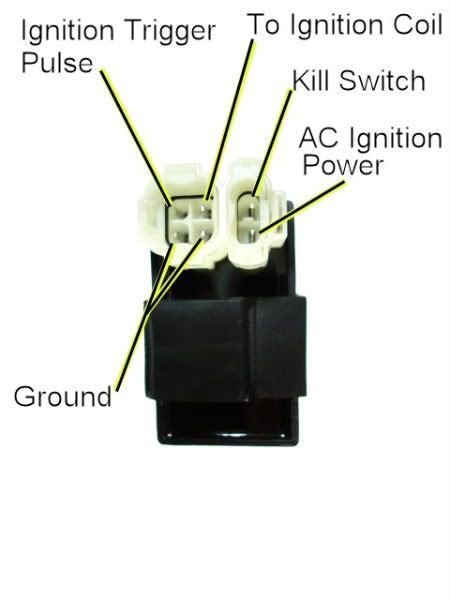
1) Unplug the CDI. Turn the ignition switch on. Set all kill switches the the "run" position. In the wiring harness, measure the resistance of the kill switch pin to the ground pin on the 20K ohm scale. It should read infinite ohms (same as when the meter leads are hanging free and not touching anything). It should not read zero ohms (shorted).
2) Leave the CDI unplugged. Use a meter to measure the resistance of the AC ignition power pin in the wiring harness to the ground wire on the 2K ohm scale. You should read approximately 400 ohms. What do you measure?
3) In a similar fashion measure the resistance of the Ignition Trigger Pulse pin to the ground pin. You should see 150 ohms or so. What do you measure?
4) Switch your meter over to measure AC volts on the 200 volt scale. Leave the CDI unplugged. While cranking the engine, measure the voltage on the AC Ignition Power pin in the wiring harness to the ground pin. You should measure 40 to 80 volts AC. What do you measure?
5) Set your meter down to the lowest scale you have for measuring AC volts. 2 volts would be ideal, but some meters don't go that low. In that case use the lowest scale you have. While cranking the engine, measure the voltage on the Ignition Trigger Pulse pin in the wiring harness to the ground pin. You should measure 0.2 to 0.5 volts AC. What do you measure?
6) Now plug the CDI back in. Measure the AC voltage on the Ignition Coil pin to the ground pin using the 200 volt scale. If you have to, use a sewing pin to poke through the wire insulation and then put the meter probe on the sewing pin. But don't hold your fingers on the connection during the next test - there may be high voltage here when the engine is turning. With the ignition on and all kill switches set to the "run" position, crank the starter motor. You should see voltages bouncing around at random values and the meter captures all or part of a spark event. What do you see?
1) Unplug the CDI. Turn the ignition switch on. Set all kill switches the the "run" position. In the wiring harness, measure the resistance of the kill switch pin to the ground pin on the 20K ohm scale. It should read infinite ohms (same as when the meter leads are hanging free and not touching anything). It should not read zero ohms (shorted).
2) Leave the CDI unplugged. Use a meter to measure the resistance of the AC ignition power pin in the wiring harness to the ground wire on the 2K ohm scale. You should read approximately 400 ohms. What do you measure?
3) In a similar fashion measure the resistance of the Ignition Trigger Pulse pin to the ground pin. You should see 150 ohms or so. What do you measure?
4) Switch your meter over to measure AC volts on the 200 volt scale. Leave the CDI unplugged. While cranking the engine, measure the voltage on the AC Ignition Power pin in the wiring harness to the ground pin. You should measure 40 to 80 volts AC. What do you measure?
5) Set your meter down to the lowest scale you have for measuring AC volts. 2 volts would be ideal, but some meters don't go that low. In that case use the lowest scale you have. While cranking the engine, measure the voltage on the Ignition Trigger Pulse pin in the wiring harness to the ground pin. You should measure 0.2 to 0.5 volts AC. What do you measure?
6) Now plug the CDI back in. Measure the AC voltage on the Ignition Coil pin to the ground pin using the 200 volt scale. If you have to, use a sewing pin to poke through the wire insulation and then put the meter probe on the sewing pin. But don't hold your fingers on the connection during the next test - there may be high voltage here when the engine is turning. With the ignition on and all kill switches set to the "run" position, crank the starter motor. You should see voltages bouncing around at random values and the meter captures all or part of a spark event. What do you see?
Feb 9, 2013 | 11:59 PM
#6
Thread Starter
|
Weekend Warrior
Joined: Feb 2013
Posts: 6
Likes: 0
Well after the odd measurement on the ignition power wire I looked around a little more and found it had been pulled out of the wire harness just enough not to make contact at the stator connector so put it back in and now its running like a champ thanks for the help I greatly appreciate it.

 .
.

Thread
Thread Starter
Forum
Replies
Last Post

Currently Active Users Viewing This Thread: 1 (0 members and 1 guests)