


GY6 CDI question
 Jan 21, 2009 | 12:38 AM
#1

Thread Starter
|
Weekend Warrior
Joined: Jan 2007
Posts: 15
Likes: 0
 GY6 CDI question
My 2006 Shinima 150 has a 4 pin CDI box. I would like to add a high performance CDI, but all the ones I find have a 6 pin connector. Do any of you know of a high performance GY6 150cc CDI or do you know if it is even possible to wire up the 6 pin box to my machine? Thanks for any info!
Jan 21, 2009 | 02:52 AM
#2

Electrical Expert
Likes High Voltage In The Tub!
Likes High Voltage In The Tub!
Joined: Dec 2008
Posts: 3,260
Likes: 14
From: Tracy, California, USA
GY6 CDI question
I've never seen a four pin CDI, but there are only four absolutely essential connections for a CDI to work so it is certainly possible. Here is the wiring for my 6 pin CDI:
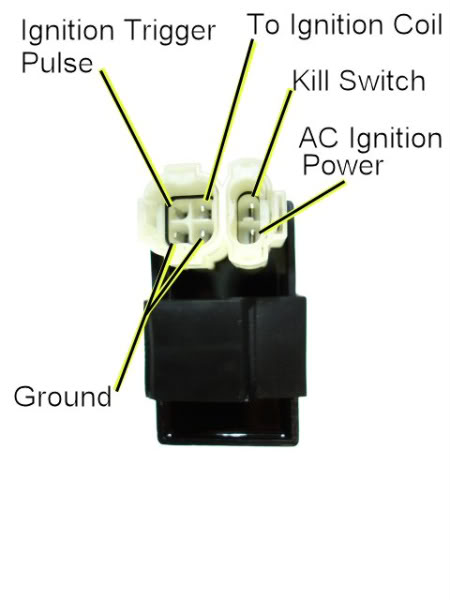
You only need one ground, and the "kill" function can be accomplished in other ways, so it is optional. That leaves these four necessary connections:
1) CDI power: Most quads use a high voltage AC winding on the stator to provide power to the CDI. A few buggies and UTV's run off 12 volts DC (they have a DC to DC convertor inside to make the couple hundred volts to charge up the discharge storage capacitor). Unless someone else knows the specifics of your CDI you will have to trace the wiring to find out which.
2) Timing / Trigger signal: This comes off the stator and triggers the CDI to fire the spark plug through the ignition coil.
3) Output: Goes to the ignition coil primary.
4) Ground: Everything needs a ground return.
The kill switch function is sometimes alternatively done in the following ways:
A) Short the timing / trigger signal line to ground, or disconnect it from the CDI.
B) Short the CDI power input to ground (high voltage AC powered devices only). The high voltage stator winding is current limited. Shorting it to ground is not harmful. If the CDI is DC powered then removing the 12 volts is what can be done.
C) Disconnect the ground wire to the CDI: No ground means the CDI doesn't work.
If your CDI is powered off high voltage AC from the stator I don't see why wiring in a six pin CDI won't work if the stator isn't non standard. Ignition advance on most non-performance CDI's is accomplished by the CDI measuring the amplitude of the timing / trigger pulse, which is directly proportional with engine speed. So the stator trigger winding and CDI have to be somewhat compatible.
You only need one ground, and the "kill" function can be accomplished in other ways, so it is optional. That leaves these four necessary connections:
1) CDI power: Most quads use a high voltage AC winding on the stator to provide power to the CDI. A few buggies and UTV's run off 12 volts DC (they have a DC to DC convertor inside to make the couple hundred volts to charge up the discharge storage capacitor). Unless someone else knows the specifics of your CDI you will have to trace the wiring to find out which.
2) Timing / Trigger signal: This comes off the stator and triggers the CDI to fire the spark plug through the ignition coil.
3) Output: Goes to the ignition coil primary.
4) Ground: Everything needs a ground return.
The kill switch function is sometimes alternatively done in the following ways:
A) Short the timing / trigger signal line to ground, or disconnect it from the CDI.
B) Short the CDI power input to ground (high voltage AC powered devices only). The high voltage stator winding is current limited. Shorting it to ground is not harmful. If the CDI is DC powered then removing the 12 volts is what can be done.
C) Disconnect the ground wire to the CDI: No ground means the CDI doesn't work.
If your CDI is powered off high voltage AC from the stator I don't see why wiring in a six pin CDI won't work if the stator isn't non standard. Ignition advance on most non-performance CDI's is accomplished by the CDI measuring the amplitude of the timing / trigger pulse, which is directly proportional with engine speed. So the stator trigger winding and CDI have to be somewhat compatible.
 Jan 21, 2009 | 08:56 PM
#5
Thread Starter
|
Weekend Warrior
Joined: Jan 2007
Posts: 15
Likes: 0
GY6 CDI question
I have found out that my CDI is 12V DC, so I am out of luck! Bummer! I guess I will roll with the stock CDI. If anyone finds out any other info about this please let me know. Thanks!
Jan 22, 2009 | 12:55 AM
#6
Electrical Expert
Likes High Voltage In The Tub!
Likes High Voltage In The Tub!
Joined: Dec 2008
Posts: 3,260
Likes: 14
From: Tracy, California, USA
GY6 CDI question
<div class="FTQUOTE"><begin quote>Originally posted by: BSpray29
I have found out that my CDI is 12V DC, so I am out of luck! Bummer! I guess I will roll with the stock CDI. If anyone finds out any other info about this please let me know. Thanks!</end quote></div>
I wonder if your GY6 quad is still using the stock 6 pole or 8 pole stator, which would still have the AC ignition power winding on it. If so you could wire it up to the AC style CDI and just abandon the 12 volt connection. On my quad (has an 8 pole stator) the AC ignition power comes out on a single red/blk wire and connects to the wiring harness through a single wire bullet connector. (Using red/black for ignition power is a fairly standard color code.) If your quad's stator has this winding the red/blk wire will be hanging free and unconnected (but accessible) outside the stator cover.
BTW, on the left side of my message under my name and history info is a camera icon. If you click on that you should have access to jpegs of my GY6 150cc wiring diagram. I had to trace out my own since none was available elsewhere.
I have found out that my CDI is 12V DC, so I am out of luck! Bummer! I guess I will roll with the stock CDI. If anyone finds out any other info about this please let me know. Thanks!</end quote></div>
I wonder if your GY6 quad is still using the stock 6 pole or 8 pole stator, which would still have the AC ignition power winding on it. If so you could wire it up to the AC style CDI and just abandon the 12 volt connection. On my quad (has an 8 pole stator) the AC ignition power comes out on a single red/blk wire and connects to the wiring harness through a single wire bullet connector. (Using red/black for ignition power is a fairly standard color code.) If your quad's stator has this winding the red/blk wire will be hanging free and unconnected (but accessible) outside the stator cover.
BTW, on the left side of my message under my name and history info is a camera icon. If you click on that you should have access to jpegs of my GY6 150cc wiring diagram. I had to trace out my own since none was available elsewhere.
Jan 22, 2009 | 02:25 AM
#7
Thread Starter
|
Weekend Warrior
Joined: Jan 2007
Posts: 15
Likes: 0
GY6 CDI question
Lynn,
I'm guessing you are some sort of an electrical guru. I know just enough about electrical to be dangerous, but I can understand much of what you say and your diagrams are top notch. Am I correct in understanding that it may be possible to convert my CDI power from DC to AC? I am going to check my stator for that red/blk wire. If it is there, I may call on you to help me with a "CDI wiring for idiots" if that's OK. My email is BSpray29@yahoo.com. Thanks a ton!
P.S. A guy at a local shop said that what I described to him was a DC CDI. Is there a way I can definitively determine for sure? Wire colors maybe?
I'm guessing you are some sort of an electrical guru. I know just enough about electrical to be dangerous, but I can understand much of what you say and your diagrams are top notch. Am I correct in understanding that it may be possible to convert my CDI power from DC to AC? I am going to check my stator for that red/blk wire. If it is there, I may call on you to help me with a "CDI wiring for idiots" if that's OK. My email is BSpray29@yahoo.com. Thanks a ton!
P.S. A guy at a local shop said that what I described to him was a DC CDI. Is there a way I can definitively determine for sure? Wire colors maybe?
Trending Topics
Jan 22, 2009 | 10:46 PM
#8
Electrical Expert
Likes High Voltage In The Tub!
Likes High Voltage In The Tub!
Joined: Dec 2008
Posts: 3,260
Likes: 14
From: Tracy, California, USA
GY6 CDI question
I've not ever changed a 12V CDI to an AC powered one, but I have read posts from others who have (usually because they can't find the 12 volt version). The key requisite is having the high voltage AC winding on the stator. AC CDI's on ebay are cheap and plentiful.
The best way to see if you have a 12 volt CDI is to trace your wiring. It isn't as hard as it seems. Visually follow each of the four wires into the wiring harness, from another wiring diagram like my hensim 150cc quad look at all the points where the wiring likely would come out of the harness, then look for the same color wire. The assumption (fairly good) is that the wire color won't change in the middle of the harness. Verify the same color wire ends as being connected with an ohmmeter, and you've got that connection nailed down. After finding the easy ones and you know what they do, then concentrate on the ones that are left . It's a process of elimination. When you've found the trigger wire, and wire to the ignition coil, that leaves ground (which may be actually grounded, or may be grounded through the ignition switch) and that leaves the power (which may be AC or DC). And remember, if it is AC is may be shorted to ground with the ignition off, and if it is DC is may only be hooked to 12 volts when the ignition is on). It's like a puzzle, but it is a solvable puzzle.
The best way to see if you have a 12 volt CDI is to trace your wiring. It isn't as hard as it seems. Visually follow each of the four wires into the wiring harness, from another wiring diagram like my hensim 150cc quad look at all the points where the wiring likely would come out of the harness, then look for the same color wire. The assumption (fairly good) is that the wire color won't change in the middle of the harness. Verify the same color wire ends as being connected with an ohmmeter, and you've got that connection nailed down. After finding the easy ones and you know what they do, then concentrate on the ones that are left . It's a process of elimination. When you've found the trigger wire, and wire to the ignition coil, that leaves ground (which may be actually grounded, or may be grounded through the ignition switch) and that leaves the power (which may be AC or DC). And remember, if it is AC is may be shorted to ground with the ignition off, and if it is DC is may only be hooked to 12 volts when the ignition is on). It's like a puzzle, but it is a solvable puzzle.
Jan 25, 2009 | 04:24 PM
#9
Thread Starter
|
Weekend Warrior
Joined: Jan 2007
Posts: 15
Likes: 0
GY6 CDI question
**************UPDATE ON CDI BOX***************
I found a 4pin racing CDI on ebay. It should be here in about a week.
I will let you know how it works. Thanks to all for your help, especially Lynn.
I found a 4pin racing CDI on ebay. It should be here in about a week.
I will let you know how it works. Thanks to all for your help, especially Lynn.

