
Honda ATV History — In the beginning
| Honda ATV History 101 | 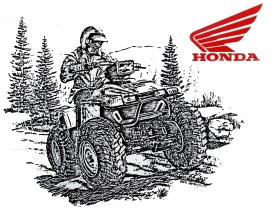 |
The all-terrain vehicle (ATV), also known as three and four-wheelers, was initially developed in Japan as a farm-to-town vehicle in isolated, mountainous areas. During spring thaws and rainy seasons steep mountainous roads were often impassable with conventional vehicles. The three-wheeled ATV proved to be a much better mode of travel and soon became a recreational vehicle, providing transportation to areas inaccessible by other motorized transport. And, it wasn’t long before the Japanese manufacturers realized that the ATV could be sold to Americans. 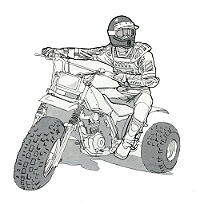
When the ATV first appeared in the United States in the early 1970’s, it was promoted and sold as a recreational vehicle designed to provide “thrills” for the rider. This is still its primary use today. Shortly, however, sportsmen found that the ATV was a useful machine to move through areas not accessible with pick-up trucks, four-wheel drives, or other motorized vehicles. The ATV became popular as a hunting vehicle and was used to reach remote areas and to transport game back out. In this two-part chronicle, we discuss Honda’s introduction, involvement, and innovation in the all-terrain vehicle industry.
| Courtesy: American Honda Motor Co. | ||
|
1987 FourTrax Foreman 4×4 (TRX350D): One year In this 1963 ad, marketers targeted the general public with good, clean two-wheeled fun, and introduced millions to motorcycling. The 1963 two-wheeler sold for 5 |
Three decades ago, the first ATV, Honda’s US 90, had a single-minded purpose: off-road recreation. But as Honda’s family of ATVs grew, so did their usefulness. Ironically, it was market strategy that at first drove ATV usage, but it was the owners who found and invented new and creative applications for ATVs, and helped shape their growth and design along the way. What these hard-working owners found out was that the ATV offered a stunning versatility even Honda engineers never dreamed of. Less expensive to operate than a pickup or tractor, smaller and more maneuverable than either one, and possessed of a remarkably light footprint (with their low-pressure tires) that was easy on sensitive terrain, ATVs became vital tools in such widely divergent fields as farming, ranching, industry, all types of agriculture, police work-even as a crucial means of mobility for the disabled. In some cases, ATVs did jobs no other vehicle could, making the impossible possible. |
|
 after the successful launch of the FourTrax 4×4, the celebrated Foreman name is born. The 350cc Foreman 4×4 featured front and rear racks, a high-output 310-watt alternator and an 850-pound towing capacity.
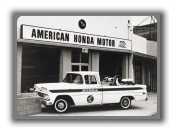
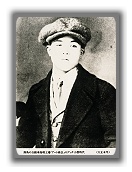 If necessity was the mother of the first ATV, Honda engineer Osamu Takeuchi was its father. In 1967,American Honda askedHonda R&D Ltd. for a new product dealers could sell when motorcycle sales cooled off in the winter. Mr. Takeuchi was assigned to lead the project, along with a small group of engineers. This was clearly the group for the job, since Takeuchi and company had been working to develop other new recreational vehicles that never saw production. These projects gave Takeuchi the tools to develop Honda’s first ATV, the US 90. Forget the proverbial blank sheet of paper. Takeuchi started in the shop with a head full of ideas and an eclectic assortment of components. Two, three, four, five and even six-wheeled configurations were examined, but the three-wheel concept delivered the best combination for the machine’s intended mission. It dealt with snow, mud and assorted slippery conditions a two-wheeler couldn’t, while providing more maneuverability than other configurations.
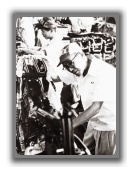 In the early stages, a Honda ST70 motorcycle gave up its 70cc four-stroke single-cylinder engine for the cause, along with assorted chassis parts. An extended rear axle carried cultivator wheels designed to handle rough terrain. Two driving wheels in the rear worked well. Cultivator tires didn’t. The biggest challenge would be finding a tire capable of getting a grip on soft, changeable terrain such as snow, sand and mud. Two wheels, three wheels, four wheels or more? Motorcycle tires weren’t an option.
The design process quickened when Takeuchi received an American invention called the “Amphi-Cat� that rolled on six 20-inch low-pressure, high-flotation balloon tires. The light bulb went on. Revamping his ST70-based prototype to accept the new low-pressure rolling stock, he went to work on his own tire design, ending up with a 22-inch design inflated to 2.2 psi. With the tire dilemma solved, the 70cc engine lacked the muscle necessary to push a full-sized rider through snow or mud. A 90cc engine running through a special dual-range four-speed gearbox added the requisite flexibility over varied terrain.
 The next phase of development was optimizing the chassis to match the new engine and tires. Testing over rough roads, sand hills and slopes as steep as 35-degrees gradually established chassis dimensions effective for recreational riding as well as agricultural work. Laid out in the shape of an isosceles triangle with the footpegs located outside the triangle to optimize control, the ATC design was unique enough to let Takeuchi patent the arrangement.
Exhaustive testing brought other lessons to light as well. Using a thumb throttle instead of the typical motorcycle twist grip let riders shift their weight for optimal vehicle maneuverability while maintaining precise throttle control. A rear differential was considered, but discarded when a live axle performed better. Though suspension is an integral part of the modern ATV, Takeuchi’s original balloon tires soaked up rough terrain best by themselves. Exerting less pressure on soft or sensitive terrain than the average human foot, those tires let the vehicle go places others couldn’t, leaving little or no evidence of their passing–an advantage that looms large in hundreds of modern ATV applications. The 1970s: The World’s First ATC
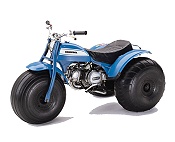 Officially introduced to America in 1970, the US 90 sent its 7 horsepower through a dual-range four-speed gearbox with automatic clutch, and sold for 5. It was renamed the ATC90 later that year as Honda trademarked the ATC name. Three models carried that Honda ATC monogram through the 1970s. The ATC70 gave younger riders a scaled-down version of the fat-tire experience. And by the end of the decade, requests for more power turned the original ATC90 into the ATC110 in 1979. The ATC was as evolutionary as it was revolutionary from the beginning.
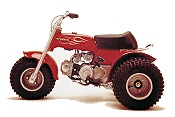 Good as the original fat tires were on snow and sand, they were vulnerable to punctures fromthings such as stubble from harvested crops. The fact that those original tires weren’t repairable compounded the problem, so a fabric carcass was added, and steel hubs replaced the first hubless wheel design in 1975. Tougher, color-impregnated plastic fenders were added in 1975 as well. Though it was primarily a recreational vehicle through the ’70s, farmers were beginning to see the ATC as a tool to make their lives easier. Engineers followed their machines into the field, gathering data to guide the machine’s natural adaptation to a rapidly growing market. The ATC was as capable at labor as at leisure, and America was catching on.