


no spark on FSN 110cc
 Sep 19, 2011 | 03:43 PM
#31

Weekend Warrior
Joined: Sep 2011
Posts: 3
Likes: 0

The trigger voltage is really important. Without it you won't get spark. There are a lot of meters that won't measure AC volts below 200 volts full scale, with a measurement resolution of only 0.1 volts. If you're lucky and your meter is well calibrated you can see a difference between the trigger voltage with the engine stopped and with it cranking even on a 200 volt AC scale. But it is also likely that you have a meter that doesn't see any difference between stopped and cranking - they both read zero even on a working quad. That doen't means the meter is bad - it means we're stretching the limits on what the meter is capable of doing.
The best bet is to see if you can come up with a meter that goes to a lower AC voltage scale like 20 volts (or even 2 volts). Or, can you measure the trigger voltage on another working quad to see if your meter can actually see a difference between the trigger voltage on a stopped engine versus a cranking engine.
Measuring the ohms of the trigger pickup coil is really important. In the vast majority of cases, if the trigger coil fails it will be open. This could be a break in the wiring, or a break in the extremely fine wire wound up in thr trigger coil itself. Or the trigger coil output could be shorted to ground (at the coil or in the trigger wiring). But even if the trigger coil reads approximately right (as in your case), this isn't good enough for a complete test. If there is a shorted turn (or turns) in the trigger coil winding the trigger voltage will be zero, yet the overall resistance will be close to normal. This is rare compared to just being open or shorted, but it does happen. This is why both tests are necessary.
The best bet is to see if you can come up with a meter that goes to a lower AC voltage scale like 20 volts (or even 2 volts). Or, can you measure the trigger voltage on another working quad to see if your meter can actually see a difference between the trigger voltage on a stopped engine versus a cranking engine.
Measuring the ohms of the trigger pickup coil is really important. In the vast majority of cases, if the trigger coil fails it will be open. This could be a break in the wiring, or a break in the extremely fine wire wound up in thr trigger coil itself. Or the trigger coil output could be shorted to ground (at the coil or in the trigger wiring). But even if the trigger coil reads approximately right (as in your case), this isn't good enough for a complete test. If there is a shorted turn (or turns) in the trigger coil winding the trigger voltage will be zero, yet the overall resistance will be close to normal. This is rare compared to just being open or shorted, but it does happen. This is why both tests are necessary.
Thanks again Eric
Sep 19, 2011 | 10:59 PM
#32

Electrical Expert
Likes High Voltage In The Tub!
Likes High Voltage In The Tub!
Joined: Dec 2008
Posts: 3,260
Likes: 14
From: Tracy, California, USA
So the next step is measuring the output of the CDI which goes to the ignition coil primary (input) winding. Earlier you said you got 1.5 volts AC there. What does your new fancy Fluke meter read here? Is it still 1.5 volts AC?
Most meters when measuring the CDI output will not give a steady reading. The meter will read lots of zeros with random values interspersed as the meter captures all or part of the CDI firing. That's why I'm curious to see if the Fluke meter reads the same.
After we digest that info it may come down to making the best judgement call we can based on the information available. Since all the inputs to the CDI are working (power, trigger, and the kill switch input open) we're left with the CDI, the ignition coil, and the the spark plug. Fortunately they are all cheap parts.
Sep 21, 2011 | 03:55 PM
#33

Weekend Warrior
Joined: Jan 2011
Posts: 20
Likes: 0
A lot of the Fluke meters have a peak hold function (My 112 has a Min/Max). This is going to be the best way to help you on that. That is how I checked the 110cc one I was working on.
I believe that Lynn posted the voltages earlier in this thread as to what they are supposed to be (a couple of times).
Jeff
I believe that Lynn posted the voltages earlier in this thread as to what they are supposed to be (a couple of times).
Jeff
Sep 21, 2011 | 11:59 PM
#34
Electrical Expert
Likes High Voltage In The Tub!
Likes High Voltage In The Tub!
Joined: Dec 2008
Posts: 3,260
Likes: 14
From: Tracy, California, USA
 . I've noticed in several factory service manuals that they specifiy using a peak detect meter to troubleshoot ignition systems.
It isn't hard to make a cheap meter into a peak detect meter using just a few extra parts at the meter input posts (from radio shack or any generic electronics supply store). It's on my list of things to do and document if I can just find some time...
 .
Sep 22, 2011 | 03:55 PM
.
Sep 22, 2011 | 03:55 PM
#35
Weekend Warrior
Joined: Jan 2011
Posts: 20
Likes: 0
Yup time and money which do you have more of? In my case it's neither 
At a lot of the places I have worked I have had to have a meter that was able to be calibrated once a year, so that only really left me with 2 options Simpson or Fluke. When I have bought meters I usually go to a pawn shop. A lot of times they will have a bunch of them. This isn't really directed to you Lynn, but for someone looking to buy a meter, my recommendation is figure out which meter has the options you need and how much it costs. Reserch meters that are a few years old and know what they went for and what they go for now that way you don't get screwed. The 112 I bought I found in a pawnshop brand new ($225 at the time, 5 years ago) with the pouch and leads was listed for $80 and I was able to talk them into $60 out the door so you can get a pretty good deal if you look.
If you are a person that does a lot of work themselves, when you need a good meter nothing else will usually do, a quality meter is essential for any electrical troubleshooting. A cheap meter may work and you can get them for less than $10 but I can't tell you how many of these cheap meters I have bought that just don't last. The digit's start tripping out or the dial breaks, cold solder joints, or it just stop working flat (even after changing the battery ) and it's just a PITA needing a tool and having to go buy a new one when the cheapy goes bad. This is one of those you get what you pay for items here.
Jeff
At a lot of the places I have worked I have had to have a meter that was able to be calibrated once a year, so that only really left me with 2 options Simpson or Fluke. When I have bought meters I usually go to a pawn shop. A lot of times they will have a bunch of them. This isn't really directed to you Lynn, but for someone looking to buy a meter, my recommendation is figure out which meter has the options you need and how much it costs. Reserch meters that are a few years old and know what they went for and what they go for now that way you don't get screwed. The 112 I bought I found in a pawnshop brand new ($225 at the time, 5 years ago) with the pouch and leads was listed for $80 and I was able to talk them into $60 out the door so you can get a pretty good deal if you look.
If you are a person that does a lot of work themselves, when you need a good meter nothing else will usually do, a quality meter is essential for any electrical troubleshooting. A cheap meter may work and you can get them for less than $10 but I can't tell you how many of these cheap meters I have bought that just don't last. The digit's start tripping out or the dial breaks, cold solder joints, or it just stop working flat (even after changing the battery
) and it's just a PITA needing a tool and having to go buy a new one when the cheapy goes bad. This is one of those you get what you pay for items here.Jeff
Dec 30, 2011 | 01:14 PM
#36

Weekend Warrior
Joined: Dec 2011
Posts: 1
Likes: 0
Hey guys, I know this is an old thread but the info here was great in determining the problem with my kids 110cc buggy. thought i'd reply and let known the prolems i had
They used it for 3 hours Christmas day then wouldn't start again. It seamed to have a weak spark. I put in a new spark plug, insulated the high tension lead, cleaned the carby, checked the valves....... still no go..... by passed the ignition switch... still no go.... replaced the cdi....still nothing..... turned out the connectors to the cdi weren't tight enough...... clamped them up a bit and got a strong spark..... and away it went..... happy day's.
thanks to all who posted before me and i hope this may help someone else with similar troubles..... thanks again
Daryl
They used it for 3 hours Christmas day then wouldn't start again. It seamed to have a weak spark. I put in a new spark plug, insulated the high tension lead, cleaned the carby, checked the valves....... still no go..... by passed the ignition switch... still no go.... replaced the cdi....still nothing..... turned out the connectors to the cdi weren't tight enough...... clamped them up a bit and got a strong spark..... and away it went..... happy day's.
thanks to all who posted before me and i hope this may help someone else with similar troubles..... thanks again
Daryl
Dec 30, 2011 | 10:39 PM
#37
Electrical Expert
Likes High Voltage In The Tub!
Likes High Voltage In The Tub!
Joined: Dec 2008
Posts: 3,260
Likes: 14
From: Tracy, California, USA
Hey guys, I know this is an old thread but the info here was great in determining the problem with my kids 110cc buggy. thought i'd reply and let known the prolems i had
They used it for 3 hours Christmas day then wouldn't start again. It seamed to have a weak spark. I put in a new spark plug, insulated the high tension lead, cleaned the carby, checked the valves....... still no go..... by passed the ignition switch... still no go.... replaced the cdi....still nothing..... turned out the connectors to the cdi weren't tight enough...... clamped them up a bit and got a strong spark..... and away it went..... happy day's.
thanks to all who posted before me and i hope this may help someone else with similar troubles..... thanks again
Daryl
They used it for 3 hours Christmas day then wouldn't start again. It seamed to have a weak spark. I put in a new spark plug, insulated the high tension lead, cleaned the carby, checked the valves....... still no go..... by passed the ignition switch... still no go.... replaced the cdi....still nothing..... turned out the connectors to the cdi weren't tight enough...... clamped them up a bit and got a strong spark..... and away it went..... happy day's.
thanks to all who posted before me and i hope this may help someone else with similar troubles..... thanks again
Daryl
Bad connections are a common problem on chinese quads.
Jan 13, 2012 | 04:02 PM
#38
Weekend Warrior
Joined: Jan 2011
Posts: 20
Likes: 0
Lynn that is the understatment of the year! I had to go through every connection of the one I was working on and solder and clean most all of the connectors and wiring. Funny thing is most of the wire looks like 18 awg but is around 20 awg. Some thick insulation.
Jeff
I had to go through every connection of the one I was working on and solder and clean most all of the connectors and wiring. Funny thing is most of the wire looks like 18 awg but is around 20 awg. Some thick insulation.Jeff
Jul 28, 2013 | 12:52 AM
#39

Weekend Warrior
Joined: Jul 2013
Posts: 1
Likes: 0
110 help
I hope this thread continues to be monitoring, because I need some help.
I followed these directions and now need some help. I have a chinese 110 in my ct70 with about 330 miles on it, and now no spark. I replaced the plug, and nothing. I then pulled the kill switch wire from the CDI harness, eliminating the issue of the problem being a kill switch issue. I also put in a new CDI and no spark.
the ignition power supply winding came in at 37 volts so I hooked up the battery to a charger and let it sit. I then got a reading of 77 volts. So I am not sure what this means? Also is the this reading for the ignition coil?
the ignition timing trigger reads .3 to .4 volts.
I have continuity from the CDI to the ground.
What else can I try and do. I still am not sure if the problem is the stator, or ignition coil? or neither.......
I followed these directions and now need some help. I have a chinese 110 in my ct70 with about 330 miles on it, and now no spark. I replaced the plug, and nothing. I then pulled the kill switch wire from the CDI harness, eliminating the issue of the problem being a kill switch issue. I also put in a new CDI and no spark.
the ignition power supply winding came in at 37 volts so I hooked up the battery to a charger and let it sit. I then got a reading of 77 volts. So I am not sure what this means? Also is the this reading for the ignition coil?
the ignition timing trigger reads .3 to .4 volts.
I have continuity from the CDI to the ground.
What else can I try and do. I still am not sure if the problem is the stator, or ignition coil? or neither.......
Does the CDI look the following picture, or does it have only four pins?
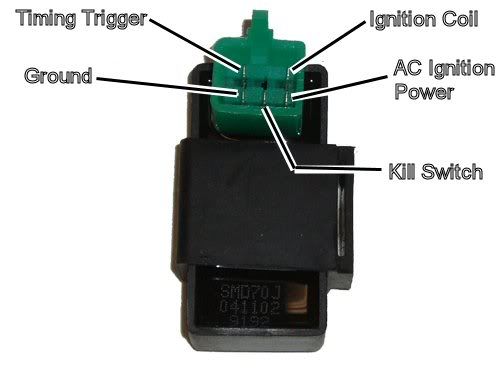
The one in the picture above is the most common one so I'll assume that as a starting point. If you have the four pin CDI then we will have to start over.
The most common cause of no spark is in the kill switch wiring. Unplug the CDI and measure the resistance of the kill switch connection in the wiring harness to ground. It should be open (infinite resistance) to get spark. If it is shorted to ground (which kills spark) then check all your kill switches and wiring to see which one is shorted. The possible kill switches are: One pole of the two pole ignition switch, the handle bar kill switch, the tether cord kill switch, and the remote control start/stop module (if installed). Unplug them one by one to find which is shorting the kill line to ground.
If the kill switch wiring is OK then the next step is to check the two spark related windings in the stator (there is a third winding in the stator for charging the battery which we will ignore since it has nothing to do with spark):
Ignition Power Supply Winding: With the CDI still unplugged, measure the AC voltage from the AC Ignition power pin at the CDI plug to engine ground while cranking the starter. You should get about 80 volts AC or so. You should also be able to measure the resistance of this winding to engine ground (engine stopped of course) at a few hundred ohms.
Ignition Timing Trigger Winding: Measure the AC voltage on the Timing Trigger pin of the CDI plug to engine ground while cranking the engine (CDI can be plugged in or not - it doesn't matter). You should see 0.2 to 0.5 volts AC. This signal is actually a bunch of very narrow +/- 5 volt pulses happening at a very low repetition rate so your meter won't measure them very well, but you should see something. You can also measure the resistance of this winding to engine ground. My 150cc quad reads 140 ohms.
Also measure the ground connection pin of the CDI plug for continuity to engine ground. The CDI needs a ground connection to work.
While your at it you should measure the igntition coil primary and secondary resistances just to make sure they aren't open.
The one in the picture above is the most common one so I'll assume that as a starting point. If you have the four pin CDI then we will have to start over.
The most common cause of no spark is in the kill switch wiring. Unplug the CDI and measure the resistance of the kill switch connection in the wiring harness to ground. It should be open (infinite resistance) to get spark. If it is shorted to ground (which kills spark) then check all your kill switches and wiring to see which one is shorted. The possible kill switches are: One pole of the two pole ignition switch, the handle bar kill switch, the tether cord kill switch, and the remote control start/stop module (if installed). Unplug them one by one to find which is shorting the kill line to ground.
If the kill switch wiring is OK then the next step is to check the two spark related windings in the stator (there is a third winding in the stator for charging the battery which we will ignore since it has nothing to do with spark):
Ignition Power Supply Winding: With the CDI still unplugged, measure the AC voltage from the AC Ignition power pin at the CDI plug to engine ground while cranking the starter. You should get about 80 volts AC or so. You should also be able to measure the resistance of this winding to engine ground (engine stopped of course) at a few hundred ohms.
Ignition Timing Trigger Winding: Measure the AC voltage on the Timing Trigger pin of the CDI plug to engine ground while cranking the engine (CDI can be plugged in or not - it doesn't matter). You should see 0.2 to 0.5 volts AC. This signal is actually a bunch of very narrow +/- 5 volt pulses happening at a very low repetition rate so your meter won't measure them very well, but you should see something. You can also measure the resistance of this winding to engine ground. My 150cc quad reads 140 ohms.
Also measure the ground connection pin of the CDI plug for continuity to engine ground. The CDI needs a ground connection to work.
While your at it you should measure the igntition coil primary and secondary resistances just to make sure they aren't open.
Aug 4, 2013 | 08:33 PM
#40

Range Rover
Joined: Jul 2010
Posts: 144
Likes: 0
From: TEXAS
burrobuddy,
Just because the CDI is new doesn't mean it is good. I bought several from the same dealer and they were bad. I had also bought several from another dealer and I was just lucky to have tried one of his which is still good and working. I went through a lot of CDIs before I got "lucky". After I got it running I went through the remaining CDIs and threw away the new ones that wouldn't work. Lynn Edwards walked me through the ordeal and I can not say enough good things about him. He gives expert advice for free and he does in a way that a person can understand.
Again let me say, I bought 6 or 7 new CDIs that were bad. I also bought 3 or 4 new ones from a different dealer that are all still good.
Just because the CDI is new doesn't mean it is good. I bought several from the same dealer and they were bad. I had also bought several from another dealer and I was just lucky to have tried one of his which is still good and working. I went through a lot of CDIs before I got "lucky". After I got it running I went through the remaining CDIs and threw away the new ones that wouldn't work. Lynn Edwards walked me through the ordeal and I can not say enough good things about him. He gives expert advice for free and he does in a way that a person can understand.
Again let me say, I bought 6 or 7 new CDIs that were bad. I also bought 3 or 4 new ones from a different dealer that are all still good.

