


Cg200 cdi
 Dec 25, 2011 | 03:37 PM
#2

Thread Starter
|
Weekend Warrior
Joined: Dec 2011
Posts: 2
Likes: 0

Would this fit?
Performance racing CDI AC fired for 150cc 200cc 250cc ATVs Dirt Bikes Scooter | eBay
Need help. Thanks.
Performance racing CDI AC fired for 150cc 200cc 250cc ATVs Dirt Bikes Scooter | eBay
Need help. Thanks.
Dec 26, 2011 | 11:30 AM
#3

Electrical Expert
Likes High Voltage In The Tub!
Likes High Voltage In The Tub!
Joined: Dec 2008
Posts: 3,260
Likes: 14
From: Tracy, California, USA
Before you buy any 6 pin CDI you need to see if your quad is wired up for a DC powered CDI or an AC powered CDI. You cannot tell by looking. You must measure. If you buy the wrong one you'll blow the new CDI up - sometimes with smoke and shrapnel.
Not that the performance CDI you listed is for an AC powered quad ignition system.
Here is the generic procedure for determining whether your quad ignition system is DC powered or AC powered:
Not that the performance CDI you listed is for an AC powered quad ignition system.
Here is the generic procedure for determining whether your quad ignition system is DC powered or AC powered:
The 2 plug 6 wire CDIs come in two different designs. One is powered off 12 volts DC, and the other is powered off a moderately high voltage AC which comes from the stator. Unfortunately there is no reliable way to tell the difference between the two by just looking at them. To be sure you need to use a meter to find out which you have:
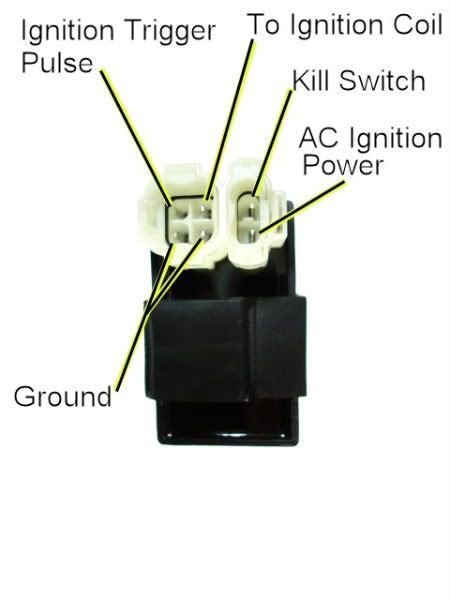
1) Unplug the CDI, and turn on the ignition. Do not crank the starter motor. Use a meter to measure the *DC* voltage on the pin labeled "AC ignition power" in the wiring harness to both ground pins in the 4 pin CDI connector. If you measure 12 volts DC then you have a DC powered CDI.
2) If you don't measure 12 volts DC on the ignition power pin, then switch the meter over to measure AC volts on the 200 volt scale. While cranking the starter motor, measure the AC voltage on the "AC Ignition Power" pin to the the Ground pin. You should see 40 to 80 volts AC. If you measure AC voltage when the starter is turning then you have an AC powered CDI.
Using a meter is the only 100% reliable way to figure out if your CDI is AC or DC powered. But there are some clues you can use that are usually (but not always) correct:
A) DC CDIs tend to be a little larger than their AC powered counterpart. This is because the DC powered CDI needs a bunch more circuitry to convert the 12 volts DC to the moderately high voltage supply that all CDIs must have.
B) Most (but not all) DC powered quad ignition systems do not use the kill switch input pin. The CDI connector pin usually has no wire tied to it. AC powered quad ignition systems usually do use the kill switch input pin.
1) Unplug the CDI, and turn on the ignition. Do not crank the starter motor. Use a meter to measure the *DC* voltage on the pin labeled "AC ignition power" in the wiring harness to both ground pins in the 4 pin CDI connector. If you measure 12 volts DC then you have a DC powered CDI.
2) If you don't measure 12 volts DC on the ignition power pin, then switch the meter over to measure AC volts on the 200 volt scale. While cranking the starter motor, measure the AC voltage on the "AC Ignition Power" pin to the the Ground pin. You should see 40 to 80 volts AC. If you measure AC voltage when the starter is turning then you have an AC powered CDI.
Using a meter is the only 100% reliable way to figure out if your CDI is AC or DC powered. But there are some clues you can use that are usually (but not always) correct:
A) DC CDIs tend to be a little larger than their AC powered counterpart. This is because the DC powered CDI needs a bunch more circuitry to convert the 12 volts DC to the moderately high voltage supply that all CDIs must have.
B) Most (but not all) DC powered quad ignition systems do not use the kill switch input pin. The CDI connector pin usually has no wire tied to it. AC powered quad ignition systems usually do use the kill switch input pin.

Thread
Thread Starter
Forum
Replies
Last Post
user 56028083
1) Engine problems..
7
Sep 13, 2010 06:27 AM

Currently Active Users Viewing This Thread: 1 (0 members and 1 guests)