


mikuni cv carb advice needed
 Jun 4, 2008 | 12:47 AM
#1

Thread Starter
|
Weekend Warrior
Joined: Jan 2008
Posts: 13
Likes: 0
 mikuni cv carb advice needed
i am currently still building my 331 big bore, and i am now up to the carb. FST told me to go up 5 sizes on the main jet. before this build i have jetted the carb and installed exhaust on the stock motor. i did not pay attention to the main jet size and just installed it (rookie mistake). but i realized stock main jet is a 125 and the one i put in with that kit is a 105. does mikuni decrease the number as the size increases or did i just really make a rookie mistake and need to go back up to a 125 or 130??????? any help is greatly appreciated.
Jun 5, 2008 | 02:55 AM
#2

Elite Pro Rider
Joined: Mar 2007
Posts: 5,227
Likes: 0
mikuni cv carb advice needed
Did FST tell you that on the phone? Or in literature??? Kustom Kraft told me on paper to use 4 sizes bigger, but the guy on the phone didn't seem that concerned. He said it was mainly for 2-stroke engine big bore kits.... Not 4-strokes. "most guys just bolt it up n go." Just because you increased the size of the bore, doesn't automatically mean you need 5 sizes bigger (or any sizes bigger). Do you really want all that carbon building up on your newly polished engine parts?
Anyway, as the jet number gets bigger, the hole gets bigger. Mikuni jet numbers are the flow rates of the jet. Dynojet numbers are the hole size. Keihin makes no logic sense how they do things.
The thing about BB kits is heat. You increased the bore, but not the heat carrying capacity (ie you didn't add more aluminum heatsink). So, just get it running good and keep it cool!
For the same size hole,,,, mikuni, dynojet, and keihin will have different numbers. For the same rated flow, you'll have YET different numbers.
Anyway, as the jet number gets bigger, the hole gets bigger. Mikuni jet numbers are the flow rates of the jet. Dynojet numbers are the hole size. Keihin makes no logic sense how they do things.
The thing about BB kits is heat. You increased the bore, but not the heat carrying capacity (ie you didn't add more aluminum heatsink). So, just get it running good and keep it cool!
For the same size hole,,,, mikuni, dynojet, and keihin will have different numbers. For the same rated flow, you'll have YET different numbers.
Jun 10, 2008 | 01:00 AM
#3
Thread Starter
|
Weekend Warrior
Joined: Jan 2008
Posts: 13
Likes: 0
mikuni cv carb advice needed
man i was having a major brain fart when i posted this message. i have the keihin cvk carb. mickey at fst told me over the phone that with the compression and the cam that i bought i would need to go up the 5 sizes due to the torque that this combo would produce. also when i jetted this carb 8 years ago i went with the dynojet kit. so i hope i havent totally confused myself
Jun 10, 2008 | 01:07 PM
#4

Elite Pro Rider
Joined: Dec 2003
Posts: 5,599
Likes: 0
mikuni cv carb advice needed
<div class="FTQUOTE"><begin quote>Originally posted by: JustRandy
Did FST tell you that on the phone? Or in literature??? Kustom Kraft told me on paper to use 4 sizes bigger, but the guy on the phone didn't seem that concerned. He said it was mainly for 2-stroke engine big bore kits.... Not 4-strokes. "most guys just bolt it up n go." Just because you increased the size of the bore, doesn't automatically mean you need 5 sizes bigger (or any sizes bigger). Do you really want all that carbon building up on your newly polished engine parts?
Anyway, as the jet number gets bigger, the hole gets bigger. Mikuni jet numbers are the flow rates of the jet. Dynojet numbers are the hole size. Keihin makes no logic sense how they do things.
The thing about BB kits is heat. You increased the bore, but not the heat carrying capacity (ie you didn't add more aluminum heatsink). So, just get it running good and keep it cool!
For the same size hole,,,, mikuni, dynojet, and keihin will have different numbers. For the same rated flow, you'll have YET different numbers.</end quote></div>
Keihin jets are the only ones which make sense. Just move the decimal place over 2 places, and thats the actual size of the hole. Example....a 145 main jet, is 1.45mm in diameter.[img]i/expressions/beer.gif[/img]
Did FST tell you that on the phone? Or in literature??? Kustom Kraft told me on paper to use 4 sizes bigger, but the guy on the phone didn't seem that concerned. He said it was mainly for 2-stroke engine big bore kits.... Not 4-strokes. "most guys just bolt it up n go." Just because you increased the size of the bore, doesn't automatically mean you need 5 sizes bigger (or any sizes bigger). Do you really want all that carbon building up on your newly polished engine parts?
Anyway, as the jet number gets bigger, the hole gets bigger. Mikuni jet numbers are the flow rates of the jet. Dynojet numbers are the hole size. Keihin makes no logic sense how they do things.
The thing about BB kits is heat. You increased the bore, but not the heat carrying capacity (ie you didn't add more aluminum heatsink). So, just get it running good and keep it cool!
For the same size hole,,,, mikuni, dynojet, and keihin will have different numbers. For the same rated flow, you'll have YET different numbers.</end quote></div>
Keihin jets are the only ones which make sense. Just move the decimal place over 2 places, and thats the actual size of the hole. Example....a 145 main jet, is 1.45mm in diameter.[img]i/expressions/beer.gif[/img]
Jun 11, 2008 | 01:09 PM
#6
Elite Pro Rider
Joined: Dec 2003
Posts: 5,599
Likes: 0
mikuni cv carb advice needed
<a target=_blank class=ftalternatingbarlinklarge href="http://i42.photobucket.com/albums/e318/gumby46/dot%20org/JetChartFull.jpg
">http://i42.photobucket.com/alb...etChartFull.jpg
</a>
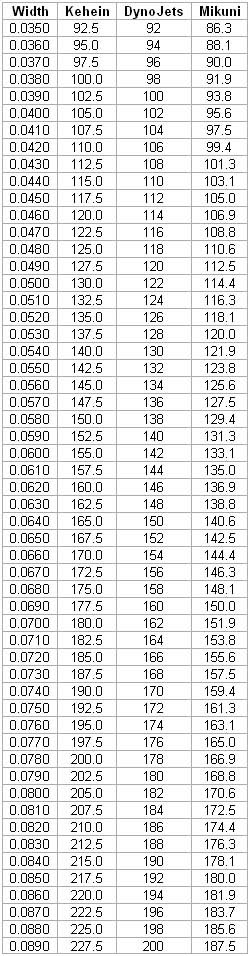
The chart is a bit small, but it shows the relationship between the different jets. Dynojets arent quite a direct conversion to mm like keihin are. They factor in the champhers, and its kind of a hybred(size and flow), where keihin is direct conversion to diameter
">http://i42.photobucket.com/alb...etChartFull.jpg
</a>
The chart is a bit small, but it shows the relationship between the different jets. Dynojets arent quite a direct conversion to mm like keihin are. They factor in the champhers, and its kind of a hybred(size and flow), where keihin is direct conversion to diameter
Jun 11, 2008 | 05:04 PM
#7
Elite Pro Rider
Joined: Mar 2007
Posts: 5,227
Likes: 0
mikuni cv carb advice needed
Using my conversion buddy, neither dynojet nor keihin work out to be whats in the "width" column. Close, but not exact. .035=.889mm. 92.5 and 92 aren't really all that close, come to think of it.
I've also seen a site that shows a graph of the flow rates of mikuni, amal, and keihin jets..... Naturally, I can't find it when I need it, lol. But it shows the mikuni or amal is what you want. They have funnels or venturis inside instead of flat holes and THAT means when you step up in jet size you get a more metered adjustment instead of just opening the hole a fixed amount.
I've also seen a site that shows a graph of the flow rates of mikuni, amal, and keihin jets..... Naturally, I can't find it when I need it, lol. But it shows the mikuni or amal is what you want. They have funnels or venturis inside instead of flat holes and THAT means when you step up in jet size you get a more metered adjustment instead of just opening the hole a fixed amount.

Thread
Thread Starter
Forum
Replies
Last Post
jrooker6
Ask the Editor
11
Apr 21, 2016 07:35 PM

Currently Active Users Viewing This Thread: 1 (0 members and 1 guests)